
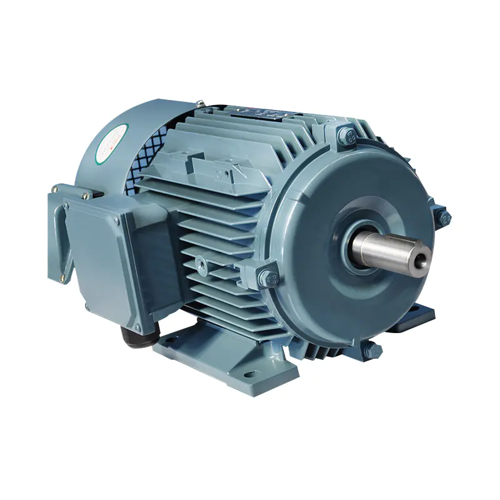

Essential details
MOQ:6
Shipping:Sea freight
Specification Number:YE3
Product Introduction

1. YE3 is ultra-high efficiency (IE3 class), focusing on basic energy-saving models, suitable for conventional industrial power needs; emphasizing general energy saving, the structural design is more aligned with replacing traditional Y-series and YX3-series motors in conventional industrial equipment, allowing direct replacement within the same frame size.
2. All are low-voltage specifications, with standard rated voltages of 380V, 660V, 380/660V, and customizable special low voltages such as 400/690V; rated frequency is 50Hz/60Hz, supporting variable frequency speed regulation (5-50Hz) to adapt to different load speed requirements.
3. Frame sizes range from 80 to 355 (covering mainstream industrial frame sizes); power range is 0.55kW to 315kW, meeting the power needs from small equipment to large production lines. Some special power ratings can be customized.
4. YE3 (IE3 class), higher cost-effectiveness, meeting basic energy saving and compliance requirements; for high energy consumption scenarios, long-term continuous operation (such as fans, pumps),
5. Stable operation, noise controlled below 85 decibels, vibration value of 2P motors as low as 1.5 mm/s, suitable for workshop scenarios with high operating environment requirements.
6. All support variable frequency operation without additional modification, featuring built-in variable frequency adaptation characteristics, wide speed regulation range (5-50Hz), enabling stepless speed regulation, adapting to different load operating requirements, with rapid start/stop, suitable for frequent acceleration/deceleration conditions.
7. Possesses CCC certification, CQC energy efficiency certification, compliant with GB/T standards; IECEX, ATEX, UL, and other export certifications, suitable for the international market; all certifications are complete, allowing for smooth passage of various safety inspections and project acceptance.
Supplementary Note: This document is a simplified version from the official website. For specific parameters, selection suggestions, and customization details, please contact us for consultation. The actual product nameplate and manual shall prevail; the product appearance uses industrial standard anti-corrosion coating, and colors can be customized according to requirements, adapting to different workshop environments.
2. All are low-voltage specifications, with standard rated voltages of 380V, 660V, 380/660V, and customizable special low voltages such as 400/690V; rated frequency is 50Hz/60Hz, supporting variable frequency speed regulation (5-50Hz) to adapt to different load speed requirements.
3. Frame sizes range from 80 to 355 (covering mainstream industrial frame sizes); power range is 0.55kW to 315kW, meeting the power needs from small equipment to large production lines. Some special power ratings can be customized.
4. YE3 (IE3 class), higher cost-effectiveness, meeting basic energy saving and compliance requirements; for high energy consumption scenarios, long-term continuous operation (such as fans, pumps),
5. Stable operation, noise controlled below 85 decibels, vibration value of 2P motors as low as 1.5 mm/s, suitable for workshop scenarios with high operating environment requirements.
6. All support variable frequency operation without additional modification, featuring built-in variable frequency adaptation characteristics, wide speed regulation range (5-50Hz), enabling stepless speed regulation, adapting to different load operating requirements, with rapid start/stop, suitable for frequent acceleration/deceleration conditions.
7. Possesses CCC certification, CQC energy efficiency certification, compliant with GB/T standards; IECEX, ATEX, UL, and other export certifications, suitable for the international market; all certifications are complete, allowing for smooth passage of various safety inspections and project acceptance.
Supplementary Note: This document is a simplified version from the official website. For specific parameters, selection suggestions, and customization details, please contact us for consultation. The actual product nameplate and manual shall prevail; the product appearance uses industrial standard anti-corrosion coating, and colors can be customized according to requirements, adapting to different workshop environments.
